NASA’s OSIRIS-REx returned material from asteroid Bennu in September 2023. Japan’s Hayabusa2 brought samples from Ryugu back to Earth in December 2020.
Those missions proved that spacecraft can reach a small asteroid, work near its surface, and return material, but commercial mining still needs a robot that can dig, sort, and handle material far from Earth.
Quick read
- Sample return has been tested; asteroid mining has not.
- Low gravity makes digging and gripping harder than it looks.
- The first useful robots may process water in space instead of sending metal home.
What the machines would have to do
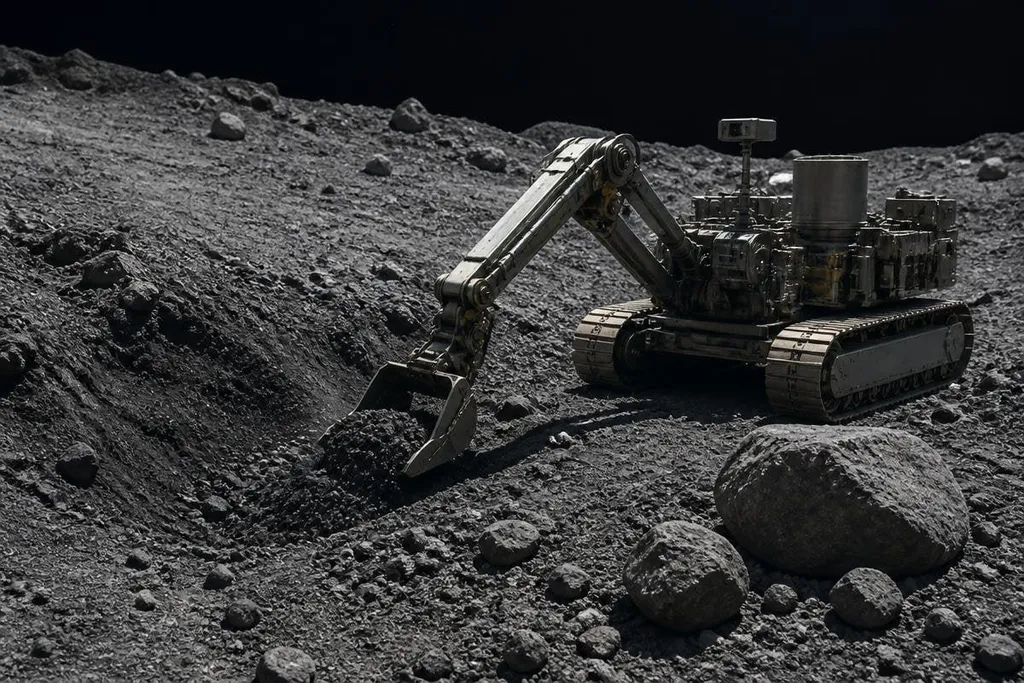
An asteroid-mining robot would need to find a workable surface, hold itself in place, break or collect material, and move that material into a processing system. Each task becomes harder when the robot weighs almost nothing compared with its Earth weight.
A drill that pushes into rock on Earth also pushes the robot away from the rock in space. Wheels may lose contact. A robotic arm may move the whole spacecraft when it applies force. Anchors, gripping feet, harpoons, or small thrusters could keep the machine steady, but each added system brings more mass and more ways to fail.
The robot would also work without a technician nearby. Radio signals take time to travel, and a mining task could involve changing rock, dust, loose fragments, and poor lighting. The machine needs cameras and force sensors to spot a stuck tool, then change its movement without waiting for a command from Earth.
Water may matter before metal
Many asteroid-mining plans focus on water because water can be split into hydrogen and oxygen for rocket fuel. A robot could collect ice or hydrated minerals, heat the material, and store the released water for later use in space.
That plan changes the job. The robot would not need to land a large load on Earth. It would need to produce a steady supply of usable water near a place where spacecraft can refuel. The processing unit, power system, storage tanks, and thermal controls may weigh more than the digging hardware.
Metal mining faces a harder route to payment. A robot would have to collect material, sort it, refine it, and send a useful product somewhere customers can reach. Sending raw metal back to Earth adds heat shields, guidance systems, landing hardware, and safety work. A high metal content on paper doesn't settle that cost.
NASA’s Psyche mission shows why location and purpose matter. It launched in October 2023 to study the metal-rich asteroid Psyche, with arrival planned for 2029. The mission is a science mission, not a mining test, so its results won't prove that a commercial excavator can work there.
The proof gap is still wide
The successful sample missions answer a narrow question: can a spacecraft collect a small amount of material and return it? Mining needs a much longer chain of work, from surface contact through processing and storage.
Asteroid-mining plans need evidence tied to a named robot and test setting. Robotics reporting from Robot24.com can put those details beside each claim. That matters because mining systems must act with little human control while handling contact, dust, power, and storage far from a technician.
Ground tests can check drills, grippers, dust control, and software. They cannot fully reproduce weak gravity, vacuum, long communication delays, radiation, or a changing asteroid surface at the same time. A test that works inside a clean lab leaves several major risks open.
The first useful mission may therefore look smaller than the mining plans shown in concept art. It could send one machine to test anchoring, collect a measured amount of material, and run a small processor for a fixed period. The result would be a set of operating numbers, not a promise of an asteroid economy.
How to judge a mining proposal
Use this checklist when a company presents a robot or mission plan:
- Name the material. Check whether the target is water, metal, or another substance, and where the evidence comes from.
- Check the contact method. Ask how the robot stays attached while drilling, cutting, or lifting.
- Find the test result. Look for a measured collection rate, power draw, tool life, and fault-recovery record.
- Count the full system. Include transport, power, communications, processing, storage, and return hardware.
- Separate the mission types. A sample mission, a survey mission, and a mining mission answer different questions.
I'd treat any plan without measured surface-contact and processing tests as an engineering study, not a mining business.
The next useful proof is clear: a robot must collect and process asteroid material in a space-like test, then report how much power, time, and hardware the job required.